click on the home button to go to the home page
|
The Industrial Era 1978 - 1979 The Third Generation of computers really gets off now,
IBM is entering the micro computer market. Less and less manufacturers
keep their systems closed to other suppliers. |
pre history | antiquity | pre industrial era | industrial era
| 1947 | 1949 | 1950 | 1952 | 1955 | 1958 | 1961 | 1963 | 1965 | 1969 | 1970 | 1972 | 1974 |
| 1976 | 1978 | 1980 | 1981 | 1982 | 1984 | 1986 | 1989 | 1991 | 1993 | 1994 | 1996 | 2000 |
| 2002 | 2005 | 2007 |
| Related Articles |
| Related Resources |
|
pre history |
 The Xerox Corporation
created a TCP enhancement: Internet Protocol (IP), a separate program that handles
the routing of individual messages.
The Xerox Corporation
created a TCP enhancement: Internet Protocol (IP), a separate program that handles
the routing of individual messages.
Combined with the TCP protocol from 1979, the two became known as TCP/IP and represented the standard system used in most large networks.
INTEL introduced
the 16-bit-8086 chip and the coprocessor 8087.
These chips were causing much excitement. But were not quickly accepted mainly because they were too advanced.(33) In later years though other chips, with a higher magnitude of possibilities, would dominate the market for years to come. It used 16 bit registers, a 16 bit databus, and 28.000 transistors using 3 micron technology. It can access 1 MB of memory. Speed is 0.33 MIPS. Later speeds included 8 and 10 MHz, 0.66 and 0.75 MIPS.
PC's grew into
complete systems: keyboard, display, floppy drives, memory, BIOS etc. and memory
was expanded up to 16 Kb.
The first 64
Kb (8 Kb) RAM memory chip were being produced in mass by IBM.
A new breed
of programs is introduced: the OPERATING
SYSTEM (OS)
Another one
of the first micro computer developments in this field was CP/M (1973); Control
Program for Micro computers and developed by Gary
Kildall of Digital Research.

An operating System lightens the burdens of a programmer to rewrite a program every time it is going to be used on a different machine, within the limits of a compatible CPU off course.
This so called OS was because of its compactness attractive enough to be accepted by all other manufacturers as a de facto standard.
Now the software industry really could take off and make affordable programs, meaning the price of software could come down. Software was still expensive and only businesses could afford to buy software packages like WordStar and VisiCalcOne question remains: will the hardware industry also start to standardize.
Computer Headware
announces WHATSIT the first database manager.
|
Personal Software released VisiCalc for the Apple II and sells it for U$100.
|
Micro Pro Int.
announced Word Master a word processor precursor to Word Star
The
first BBS (Bulletin
Board System) created by Ward Christen (USA), member of a Chicago user group
went "on air" this year.
He writes the BBS program for a do it your self computer (a Northstar Horizon CP/M-machine) that can answer a 110-bps-modem. Members (often a computer club) dial up a BBS to leave a message or download software(34). In the future the functionality of a BBS will not expand much beyond the basics: download directories, interest groups, and electronic mail (e-mail).
There is a
lot of resistance in the United Kingdom against the overpriced American computers
for private use.
Responding on this signal in the market a company called Lynx (subsidiary of NASCO USA) introduces an affordable "computer kit". Instead of using a monitor people have to use their own television. For data storage a cassette recorder is used. The operating system is embedded in an 8Kbyte EPROM(35). The kit consists of a: Mostek Z80 processor, QWERTY keyboard, 16Kbyte of memory and sold for 250 Sterling Pound. (App. 750 U$)
Oracle's first
version of the Oracle database management system (DBMS) is released and becomes
the standard database for mainframe
and Client/Server networking.(25)
Packaged with this first version is the SQL query language making it relatively easy to retrieve data by (structured) queries.
Niklaus Wirth
developed Modula -2 derived from Pascal with a few improvements. It is implemented
one year later on the PDP-11 using the Medos -2 operating system.(25)
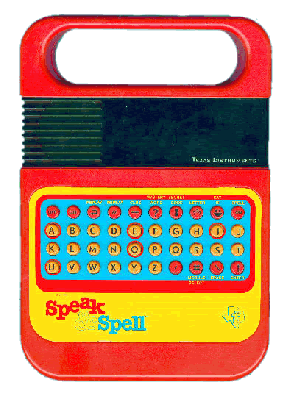
Texas Instruments
introduced a computer for kids, the Speak & Spell talking learning aid,
for ages 7 and up.
In fact a revolutionary idea to have the kids type in the words and the machine spoke it aloud. It meant the perfect learning aid, taking into account the state of the art speech synthesis at that time. Soundbit
Epson announces
the MX-80 dot matrix printer, which establish
a new standard in high performance printing for a low price.
The machine is created by Chris Rutkowski and will be put on the market in 1980. Chris still has one of the very first machines: serial nr. 0000002 and it sits in a box in his garage. According to Chris number #1 never came to America (38)

Atari announced
the Atari 400 and 800 personal computers both with a 6502 CPU
Houston Inst.
announced the Hi Plot plotter.
Summagraphics
announced Bit Pad the first digitizer.
The first "hypermedia"
presentation, the Aspen Movie Map, is created by MIT researchers.(3)
One of these famous quotes to get a smile on your face: "To err is human, but to really foul things up requires a computer." — Farmer's Almanac, 1978 |
|---|
1979 |
||
|
Microsoft develops a database, an electronic file system |
|
|
Oracle introduces the first commercial SQL relational database management system. |
|
|
Texas Instruments introduces the TI 99/4 (not the 4A) for an initial price of US$ 1500.
|
|
|
Motorola introduces the powerful 16bit 6800 chip which operates internally with 32bit registers.
|
|
|
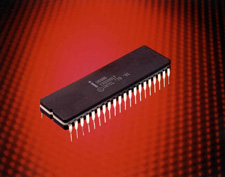
Intel introduces the 8088 which uses a 8 bit data bus, but inside still operates on a 16 bit architecture.
|
|
|
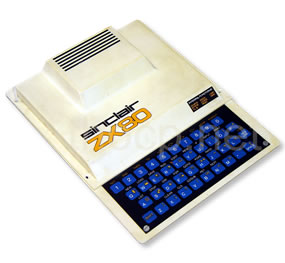
Sinclair Research introduces the ZX80 on the market.
|
|
|
In this year two games are introduced: Space Invaders and Pacman.
|
see our timeline of VideoGames |
|
MicroPro, founded by Rob Barnaby and Seymon Rubenstein, develop the program WordStar.
|
|
|
Xerox, DEC and Intel introduced the "Ethernet" standard for local networks.
|
|
|
Hayes Microcomputers Products announced the Micromodem 100 the first commercial modem. It could transmit at 110 to 300 bps. | |
|
CompuServe and The Source on-line services open. |
|
|
The first Computerized Bulletin Board System (CBBS) opened to the public in Chicago. |
|
|
Three students on two universities of North Carolina (USA) used the Unix to UNIX Copy Program (uucp) to put messages in a newsgroup. Usenet was born. By 1991 Usenet hosts more than 35,000 nodes. (25) |
|
|
Magic Wand, a word processor program became a competitor for Word Star. (25) |
|
|
Wayne Ratliff developed the Vulcan database program based on the concept of JPLDIS, a database program that ran on JPL computers.
|
|
|
Texas Instruments releases the first 16-bit processor on the market: 9900 |
|
|
The Ada programming language is developed by US Department of Defense.
|
|
|
The first Atari microcomputers Atari 400 and 800 are introduced on the market.
|
|
|
1979-82 Bjarne Stroustrup of Bell Laboratories in New Jersey introduces "C with Classes." |
|
|
PROMPTII is adopted by the CCTA (the forerunner of the OGC), as the default method for all government information systems projects in the UK.(3) |
|
|
April, Kevin McKenzie of Arpanet's MsgGroup poses the following suggestion:
|
|

|
Last Updated on May 3, 2007 | For suggestions please mail the editors |
Footnotes & References