


click on the home button to go to the home page
|
The Industrial Era 1950 - 1951 The next generation of computers announced itself. Programming them became a lot easier.
|
pre history | antiquity | pre industrial era | industrial era
| 1947 | 1949 | 1950 | 1952 | 1955 | 1958 | 1961 | 1963 | 1965 | 1969 | 1970 | 1972 | 1974 |
| 1976 | 1978 | 1980 | 1981 | 1982 | 1984 | 1986 | 1989 | 1991 | 1993 | 1994 | 1996 | 2000 |
| 2002 | 2005 |
| Related Articles |
 |
| Related Resources |
|
pre history |
 De MARK III (1951?) based on
a design for only vacuum tubes was finished. This computer got its data via
a magnetic tape. The machine weighed 35 metric tons and had 700.000 separate
parts - e.g. 3000 bearings. An addition took 0.3 seconds and a multiplication
6 seconds.
De MARK III (1951?) based on
a design for only vacuum tubes was finished. This computer got its data via
a magnetic tape. The machine weighed 35 metric tons and had 700.000 separate
parts - e.g. 3000 bearings. An addition took 0.3 seconds and a multiplication
6 seconds.
 Maurice
V. Wilkes at Cambridge university uses assembler (symbolic assembly language)
on the EDSAC. Assembler is developed by David
Wheeler under Wilkes' management in 1949
Maurice
V. Wilkes at Cambridge university uses assembler (symbolic assembly language)
on the EDSAC. Assembler is developed by David
Wheeler under Wilkes' management in 1949
Zuse
sold Z4, world's first commercial computer.(7)

SWAC
August 17,
tThe Standards Werstern Automatic Computer (SWAC), built under Harry Huskey's
management, is switched on at UCLA (University of California, Los Angeles USA).
The first entirely
commercial special purpose designed computer is made in the USA: ERA1101. This
one uses a magnetic drum as memory and can store 1 million bits. The machine
was designed to read bank checks printed with special magnetic ink.
Moe Abramson
and Stanislaus F. Danko develop the "Auto-Sembly" process, in which
component leads are inserted into a copper foil interconnection pattern and
dip soldered. With the development of board lamination and etching techniques,
this concept evolves into the standard printed circuit board fabrication process
in use today.(21) In 1956 the patent will be awarded by the
American Patent Buro (see picture below)

picture courtesy Smithsonian
digitally enhanced by THOCF

May 10, the
Pilot ACE is completed at England's National Physical Laboratory and runs its
first program.
Remington Rand
buys the Eckert-Mauchly Computer Corporation.
One of these famous citations "He couldn't be wrong more" 1950 Howard Aiken, chief designer of the Mark I, during a conversation to John Curtiss, of the National Council of Investigation of the U.S.A. in reference to the situation of the investigation and development of the UNIVAC. "We will never have enough problems to have enough work for one or two computers working on it |
Shannon proposes
the idea of a chess program.
Turing Test proposed
(Turing's "Computing Machinery and Intelligence")
The
company Wang Labs, funded by Wang's family, is founded by An Wang. Their first
invention is the ferrite core memory.  A
core memory is a system of copper wires mounted on a frame. At cross points
a ferrite core is mounted. When a cross point becomes conductive (electrical
current is running through the wires) the ferrite core becomes magnetic.
A
core memory is a system of copper wires mounted on a frame. At cross points
a ferrite core is mounted. When a cross point becomes conductive (electrical
current is running through the wires) the ferrite core becomes magnetic.
By detecting which core is magnetic and which not one could "determinate"
certain values. With these values can be made calculations. The core memories
were made by hand, therefor very expensive. But they were more solid and reliable
than vacuum tubes
F.W. Viehe independently
of Wang Labs also invented the ferrite core memory.
Coronado Corporation
changed its name into Texas Instruments Incorporated.
The largest
vacuum tube computers ever build were those for the SAGE project an USA airforce
project build by IBM consisting of 50 computers. It was also the very first
air defense system and the first one with real time computer human interfaces.

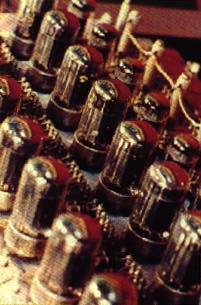 (1)
(1)
The Whirlwind
computer is designed by Jay Forrester and Ken Olsen of MIT (Boston, USA).
The speed of Whirlwind made it possible to show the results of calculations
almost at once on the computer screen. Forrester used an invention he made in
1949: "iron cores" to meet the speed required for the Whirlwind, the
patent will be awarded in 1956. The Whirlwind was also the first real time computer.
 Dr.
W. B. Shockley, R.L. Wallace and Morgan Sparks show the worlds first reliable
Junction Transistor, invented a year befor. A kind of three layered Germanium
sandwich built into a metal housing of some 12 mm's high.
Dr.
W. B. Shockley, R.L. Wallace and Morgan Sparks show the worlds first reliable
Junction Transistor, invented a year befor. A kind of three layered Germanium
sandwich built into a metal housing of some 12 mm's high.
Read on
transistors.
on
transistors.
David
A. Huffman (1926 - 1999) (USA) developed the Huffman Code. This
code that will be used to compress data to be transmitted over networks and
modems, programming for video recorders and high definition television. The
algorithm Huffman designed made it possible to compress data over 25%, depending
on the type of data. That saved a lot of time and money if you know that transmissions
were done by 110 bits per second(13)
Professor Robert M. Fano (MIT, Boston USA) put Huffman to a choice: either an assignment to graduate or a final exam. Huffman choose the assignment.
The assignment was:
"Design with the help of binary code (0 en 1) the most efficient method to represent characters, figures and symbols."
Such a code could send information over the network or be saved in a computer's memory
The assignment sounded simple but after some months of studying and trying this appeared not the case to Huffman, on the verge to give up he got suddenly the insight of a solution. He thought of using the so called binary tree technique.
|
The binary tree The principle of the code is as follows: Assign to the most frequently used characters the shortest binary code, as at the other hand the less used symbols gets the longest binary code. This process is done by a kind of coding tree. The probability that the symbol occurs is represented as a leaf on a tree. The two lowest probabilities will be added to form a new probability. The combinations of these probabilities will go via the branches of the tree until the last to numbers are 1 and 0. Thus forming the root of the tree Each probability is a leaf, each branch get a 1 or 0. Code words are formed via branches from the root till the top of the tree. In that way the binary code is formed When characters are formed, an E for example - having a probability of approximately 0.13 - could be represented as short living.(4) and thus a short binary code. |

Singer introduced
the first electronic sewing machine. This was a prime example what electronics
could do. It meant that 350 expensive fine mechanical precision parts were replaced
by logic in a cheap special purpose processor.
Magnetic data
tape always tore up when the tape was suddenly stopped or started and that formed
a problem. IBM solved this with the vacuum column. By pulling vacuum in
a column the tape always stayed down in a half loop. Because there is no resistance
from the air any more that curled up the tape(15),
the tape stayed down. That again could be used to reach higher speeds and thus
higher data transfer speeds. This technique would be used throughout the industry.(5)
In this year
three famous computers came on line:
The Ferranti
Mark 1, the first commercially available computer, is delivered to Thomas Kilburn
and Frederic Williams at Manchester University in England. Nine more are sold
in the next six years.
Heinz Nixdorf
developed a "small size" calculator for the Rheinisch-Westfälische
Elektrizitätswerke. It was unique for its kind because up till now computers
took up at least more than one room.
In the United Kingdom (GB) the
first for generic business purposes designed computer was delivered: LEO.
(Lyons Electric Office) This one will be primarily used for calculations
of wages and process control(6)(18)
Maurice
Wilkes realized soon after the completion of the work on EDSAC
at Cambridge University that "a good part of the remainder of [his] life was
going to be spent in finding errors in ... programs." With Stanley Gill and
David Wheeler he developed the concept of subroutines in programs to create
reusable modules; together they produced the first textbook on "The Preparation
of Programs for an Electronic Digital Computer".
The formalized concept of software development (not named so for another decade)
had its beginning. (19)
In
Australia a computer initially known as the CSIR Mk1, (later as CSIRAC) is one
of the world’s earliest storedprogram electronic digital computers. Coincidentally,
it is also the first computer to play music. Geoff Hill, a mathematician and
Australia’s first real software engineer, programs the CSIR Mk1 to play
popular musical melodies through its loudspeaker. At least the date of august
1951 is sure as it is demonstrated at the Australian Computer Conference in
this year.(22)

shockley explaining the junction transistor
William Shockley
invents the junction transistor.

|
Updated on June 21, 2006 | For suggestions please mail the editors |
Footnotes & References
