click on the home button to go to the thocp home page
|
The era of Antiquity (continued) 1810 - 1829 The era of Antiquity can be seen as the era of calculator devices without memory. Dial or indicators serve as output mechanism.
|
pre history | antiquity
| pre industrial era | industrial
era
1620 -
1672 - 1773 - 1810
- 1830 - 1846 - 1874
| Related Articles |
| Related Resources |
|
|
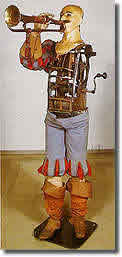
 Friedrich Kaufmann constructed an automation that could blow
a trumpet.
Friedrich Kaufmann constructed an automation that could blow
a trumpet.
The mechanism was build from two blowers and 12 "tonal" tongs. By passing the air over one of the tongs through some sort of an assembly of levers the air resonated in a particular tone. The horn worked like an amplifier and gave at the same time the sound of a trumpet. The automation was powered by a coiled spring. Special to this device was that it was the first of its kind not using static mechanical parts to do its trick.
 December 10, Ada Augusta Byron
is born - later Ada Lovelace.
December 10, Ada Augusta Byron
is born - later Ada Lovelace.
She would be the worlds first programmer by developing the "MNEMONIC" technique to facilitate assembler commands. In 1980 a programming language will be named after her: ADA. She died on 27 November 1852 in London from a cancer of the uterus.(18)

 (13b)Charles Xavier
Thomas of Colmar 1785-1870 (France), while serving in the French army, had
the idea of building a calculating machine.
(13b)Charles Xavier
Thomas of Colmar 1785-1870 (France), while serving in the French army, had
the idea of building a calculating machine.
His prototype was introduced in this year. It is the first commercially successful adding machine that was produced in large quantities. Thomas used the stepped drum principle of Leibnitz. His invention was the result of 150 years of growing industrialization - eliminating problems that had made the early machines so difficult to perfect. The stepped drum in Thomas' Arithmometer was used in conjunction with a simple system of counting gears and an automatic carry. The success of the machine was due to the many springs and other contrivances that neutralized the momentum of moving parts so they would not carry beyond their intended point - the cause of failure from earlier machines. (13b) But the major innovation was to reverse the operating function in the result registers (up to sixteen digits) that allowed for reliable and stable calculation over extended periods of time without gear realignment.(19)
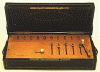
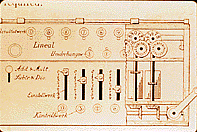 As said the machine was based on the principle developed by
Leibnitz's stepped cylinder (cylinders with sprockets at a predefined position).
As said the machine was based on the principle developed by
Leibnitz's stepped cylinder (cylinders with sprockets at a predefined position).
The machine was shown to the French Academy of Sciences and became an instant success.(12) This academy was and still is a very influential organization that could make or break your idea or machine by the flick of a pen.
The machine could be set for addition / multiplication or, by moving the lever, to subtraction / division. It was simple to use and accurate.
For all this, it met with the usual resistance to change. Scientific American wrote in 1849: "M. Colmar, a French gentleman who invented a calculating machine about 20 years ago improved it in such a wonderful manner that it is said to be one of the most astonishing pieces of mechanism that has ever been invented. But to our view, its complexity shows its delectability."
Which goes to show how wrong predictions could be since types of he Thomas Arithmometer were still selling into the 20th century. (see also 1823 for an improved version of the calculator)
 |
|
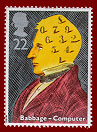 |
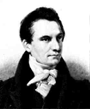
One of these famous citations I wish to God these calculations had been executed by steam 1821, Charles Babbage |
Michael Faraday,
known as the father of electricity, reported his discovery of electromagnetic
rotation and build the first of two engines that were driven by electricity.
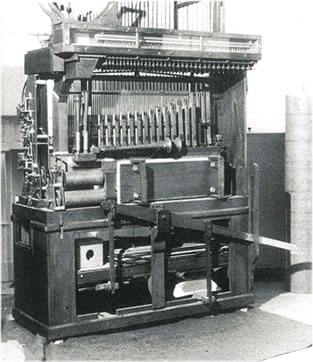
back of the Componium; showing drum, bellow and pipes (2)
D.N. Winkel (1777-1826) inventor of the metronome, constructs
a mechanical harmonium or organ called the "Componium".
Though not the first of its kind (Pinchbeck et al 1762-1766 constructed the first one) this instrument is the culmination of technological state of the art in this time. The instrument can imitate a small orchestra and plays from a barrel (stepped drum) and represents a fine example of preprogrammed processes. Looking at the layout of the music 'program' it looks like a binary notation. The first two melodies it is programmed to play are "Anacreon" by Cherubini, and "Clemenza di Tito" by Mozart. The Componium is now exhibited in the Bruxelles Museum of Music Instruments. Other examples can be seen in museums in Den Haag (NL)and Utrecht (NL) (4)
 Charles Babbage
designed a calculator.
Charles Babbage
designed a calculator.
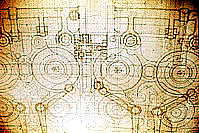
The concept of this machine was that it's operated by punched cards (see Jacquard 1801) and the results printed on paper. To print the results was a revolutionary idea. However Babbage thought that the technology of his days was not sophisticated enough (precision of tooling etc.) to realize such a machine. But a small scale model is shown at a meeting of the Society.
Mechanical (tolerances), financial (subsidies) and differences of opinion with his chief engineer - Joseph Clement (a tool engineer and draftsman, a rare combination in these days) - caused the project to be shelved in 1833. But the concept of the machine is extremely advanced and probably too far out of most people's league for this era.
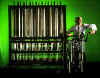 In 1990-1991 Reg Crick en Barry
Holiday(13) - two engineers of the Science
Museum in London - reconstructed the calculating section of the Difference
Engine.
In 1990-1991 Reg Crick en Barry
Holiday(13) - two engineers of the Science
Museum in London - reconstructed the calculating section of the Difference
Engine.
They used the original designs. This reconstruction will be called Difference Engine 2. The engineers at the Science museum in London are still expanding the machine and in 2002 a printing section was added according to Babbage's design.
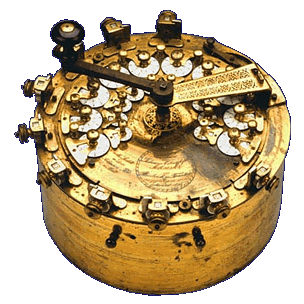
J.C. Schuster's Calculator(6)
This cylindrical calculating machine is build between 1820-1822 by Johann Christoph Schuster (1759-1823). This object is one of the last testimonies of the pre-industrial era of mechanical calculation. This is also one of the rare objects that just pops up in the river of time, in 1993 its discovery meant a small sensation. It is on display in the Arithmeum in Bonn (Germany), a museum dedicated to the science of mathematics and in this context to rare calculators. (see museums you should visit)
Thomas de Colmar (France) introduced
an improved version of the Arithmometer with all
four basic calculations - add, subtract, divide, and multiply. This device made
no errors.
The first person to prepare silicon pure enough to allow even
a first-order description of its physical and chemical properties was the Swedish
chemist Jons Jakob Berzelius.
His preferred procedure employed metallic potassium to react with potassium fluorosilicate, a solid white salt, according to the reaction 4K + K2SiF6 => Si +6KF. The reaction is energetic, the driving force allowing no give or take, and as a result, the silicon product emerges as finely divided granules mixed with residual salt.(1) Only in 1941 a physicist named Marcus Olson will succeed to make Silicon pure enough to be useful in chips
George Simon Ohm introduces Ohm's law in the book: "Die
galvanische Kette, mathematisch bearbeitet". (3)
The first electromechanical
clock is constructed in Europe, it only has a bell and no hands.
Knowledge gained from clock mechanisms design shall be important for the coming development of calculators.
William Austin Burt patents a workable typewriter, the first
writing machine in the USA

|
Last Updated on 16 February, 2006 |
For suggestions please mail the editors |
Footnotes & Reference