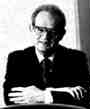
Benoit Mandelbrot

|
principal papers hardware software keywords see also related subjects |
Achievement Benoit Mandelbrot was largely responsible for the present interest in fractal geometry. He showed how fractals can occur in many different places in both mathematics and elsewhere in nature.
Biography Mandelbrot was born in Poland in 1924 into a family with a very academic tradition. His father, however, made his living buying and selling clothes while his mother was a doctor. As a young boy, Mandelbrot was introduced to mathematics by his two uncles. Mandelbrot's family emigrated to France in 1936 and his uncle Szolem Mandelbrojt, who was Professor of Mathematics at the Collège de France and the successor of Hadamard in this post, took responsibility for his education. In fact the influence of Szolem Mandelbrojt was both positive and negative since he was a great admirer of Hardy and Hardy's philosophy of mathematics. This brought a reaction from Mandelbrot against pure mathematics, although as Mandelbrot himself says, he now understands how Hardy's deep felt pacifism made him fear that applied mathematics, in the wrong hands, might be used for evil in time of war. Mandelbrot attended the Lycée Rolin in Paris up to the start of World War II, when his family moved to Tulle in central France. This was a time of extraordinary difficulty for Mandelbrot who feared for his life on many occasions. In [3] the effect of these years on his education was emphasised:- The war, the constant threat of poverty and the need to survive kept
him away from school and college and despite what he recognises as
"marvellous" secondary school teachers he was largely self
taught.
After completing his studies at the Ecole Polytechnique, Mandelbrot went to the United States where he visited the California Institute of Technology. After a Ph.D. granted by the University of Paris, he went to the Institute for Advanced Study in Princeton where he was sponsored by John von Neumann. Mandelbrot returned to France in 1955 and worked at the Centre National de la Recherche Scientific. He married Aliette Kagan during this period back in France and Geneva, but he did not stay there too long before returning to the United States. Clark gave the reasons for his unhappiness with the style of mathematics in France at this time [3]:- Still deeply concerned with the more exotic forms of statistical
mechanics and mathematical linguistics and full of non standard creative
ideas he found the huge dominance of the French foundational school
of Bourbaki not to his scientific tastes and in 1958 he left for the
United States permanently and began his long standing and most fruitful
collaboration with IBM as an IBM Fellow at their world renowned laboratories
in Yorktown Heights in New York State. With the aid of computer graphics, Mandelbrot who then worked at IBM's Watson Research Center, was able to show how Julia's work is a source of some of the most beautiful fractals known today. To do this he had to develop not only new mathematical ideas, but also he had to develop some of the first computer programs to print graphics. The Mandelbrot set is a connected set of points in the complex plane. Pick a point Z0 in the complex plane. Calculate: On 23 June 1999 Mandelbrot received the Honorary Degree of Doctor of Science from the University of St Andrews. At the ceremony Peter Clark gave an address [3] in which he put Mandelbrot's achievements into perspective. We quote from that address:- ... at the close of a century where the notion of human progress
intellectual, political and moral is seen perhaps to be at best ambiguous
and equivocal there is one area of human activity at least where the
idea of, and achievement of, real progress is unambiguous and pellucidly
clear. That is mathematics. In 1900 in a famous address to the International
Congress of mathematicians in Paris David Hilbert listed some 25 open
problems of outstanding significance. Many of those problems have
been definitively solved, or shown to be insoluble, culminating as
we all know most recently in the mid-nineties with the discovery of
the proof of Fermat's Last Theorem. The first of Hilbert's problems
concerned a thicket of issues about the nature of the continuum or
the real line, a major concern of 19th and indeed of 20th century
analysis. The problem was both one of geometry concerning the nature
of the line thought of as built up of points and of arithmetic thought
of as the theory of the real numbers. The integration of those two
fields was one of the great achievements of Richard Dedekind and George
Cantor, the latter of whom we [St Andrews University] were intelligent
enough to honour in 1911. As well as IBM Fellow at the Watson Research Center Mandelbrot was Professor of the Practice of Mathematics at Harvard University. He also held appointments as Professor of Engineering at Yale, of Professor of Mathematics at the Ecole Polytechnique, of Professor of Economics at Harvard, and of Professor of Physiology at the Einstein College of Medicine. Mandelbrot's excursions into so many different branches of science was, as we mention above, no accident but a very deliberate decision on his part. It was, however, the fact that fractals were so widely found which in many cases provided the route into other areas [3]:-
Chronology
Honors and awards Mandelbrot has received numerous honours and prizes
in recognition of his remarkable achievements. For example, in 1985
Mandelbrot was awarded the 'Barnard Medal for Meritorious Service
to Science'. The following year he received the Franklin Medal. In
1987 he was honoured with the Alexander von Humboldt Prize, receiving
the Steinmetz Medal in 1988 and many more awards including the Nevada
Medal in 1991 and the Wolf prize for physics in 1993.
|

|
Last Updated on June 24, 2006 | For suggestions please mail the editors |
Footnotes & References
| 1 | Article by: J J O'Connor and E F Robertson |
| 2 | |
| 3 |