Grace Murray Hopper

|
principal papers hardware software
keywords
see also
related subjects |
Achievement Naval officer
and computer scientist developed the first working compiler and
led the effort in the 1960s to develop COBOL (Common Business-Oriented
Language) a programming language still in use.
Biography Grace Hopper was born Grace Brewster Murray, the oldest of three children. Her father, Walter Murray, was an insurance broker while her mother, Mary Van Horne, had a passion for mathematics which she passed on to her daughter. Both Grace's parents believed that she and her sister should have an education of the same quality as her brother. In 1928 she graduated from Vassar College with a BA in mathematics and physics and joined the Vassar faculty. While an instructor at Vassar, she continued her studies in mathematics at Yale University, where she earned an MA in 1930 and a PhD in 1934. She was one of four women in a doctoral program of ten students,and her doctorate in mathematics was a rare accomplishment in its day. Hopper joined the military as soon as the United States entered World War II. However at 34 she was too old (and not heavy enough for her height) to enlist and as a mathematics professor her job was considered essential to the war effort. She was determined to join the Navy and, despite being told that she could serve her country best by remaining in her teaching post at Vassar College, After initial training at Midshipman's School, after which she was commissioned a Lieutenant, Hopper was assigned to the Bureau of Ordnance Computation Project at the Cruft Laboratories at Harvard University. Upon her arrival at Cruft Laboratory she met the
Mark I computer. For her it was an attractive gadget, similar to
the alarm clocks of her youth; she could hardly wait to disassemble
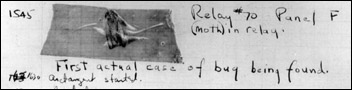
it and figure it out... In 1949 Hopper joined the Eckert-Mauchly Computer Corporation as a Senior Mathematician and there she worked with John Eckert and John Mauchly on the UNIVAC computer. She designed an improved compiler while working for the company and was part of the team which developed Flow-Matic, the first English-language compiler. In 1951 a maintenance engineer discovered a moth stuck in one of the relais. She pasted the "computer bug" as it is known from now on, into the UNIVAC I logbook. Earning eternal fame.
Perhaps her best-known contribution to computing was the invention
of the compiler (1952), the intermediate program that translates English
language instructions into the language of the target computer. She
did this, she said, because she was lazy and hoped that "the
programmer may return to being a mathematician''. Her work embodied
or foreshadowed enormous In 1950 the Remington Rand Corporation acquired the Eckert-Mauchly Computer Corporation and changed its name to the UNIVAC Division of Remington Rand. Hopper became a Systems Engineer and Director of Automatic Programming Development of the UNIVAC Division. She continued her work on compilers, publishing her first paper on that topic in 1952. She then participated in the work to produce specifications for a common business language. Since Flow-Matic was the only existing business language at that time, it was inevitable that it should provide the foundations for the specification of the language COBOL (COmmon Business-Oriented Language) which eventually would be pubshed in 1959. She had another important goal relating to compilers, namely that there should be a certain standardisation. Her aim was that there should be international standardisation of computer languages and she strongly advocated validation procedures. Hopper was not one to hold a single job for a long time. She was involved both with the academic world and with the Navy during the time that she held her positions at the Remington Rand Corporation and the Sperry Corporation. Both merged in 1955. Her connections with the academic world were many, sometimes she held visiting positions. Like in 1959 when she was a Visiting Lecturer at the Moore School of Electrical Engineering of the University of Pennsylvania. She was a consultant and lecturer for the United States Naval Reserve up to her retirement in December 1966, by which time she had reached the rank of Commander. The Navy and Hopper were not apart for very long for, in August 1967, she was recalled to active duty in the Navy. At this time she took military leave from the Sperry Corporation and did not return to that job. She retired in 1971 when she reached the age of 65. Her return to the Navy though was intended to be for only six months: ... at the request of Norman Ream, then Special Assistant to the Secretary of the Navy for Automatic Data Processing. After these six months were up, her orders were changed to say her services would be needed indefinitely. After a career which involved many jobs in numerous quite different areas, one might have expected her to look forward to a quiet retirement. However, this was not her style and, remarkably, she was appointed as senior consultant to Digital Equipment Corporation after retiring from the Navy, a position she held until 1990. Her job involved representing: ... Digital at computer industry forums, making presentations
on advanced computing concepts and the value of information and data,
and serving as a corporation liaison with educational institutions.
For her pioneering work and leadership in the development of computer
software, and for her impact and influence on the computing profession
and her fellow colleagues, and for her pioneering work and leadership
in the development of important concepts for mathematical and business
compilers, and for her contributions to the development and acceptance
of English-language, problem-oriented programming, and for her outstanding
work and continued efforts in the education and training of men
and women for careers in computer science and data processing. Grace Murray Hopper spent much of her inventive career proving that something that's never been done before isn't impossible. It was this kind of positive thinking that inspired Hopper to invent the first computer "compiler" in 1952. This revolutionary software facilitated the first automatic programming of computer language. Before Hopper's invention, programmers had to write lengthy instructions in binary code (computer language) for every new piece of software. Because binary code consists solely of 0's and 1's, it was difficult for programmers to get through their time-consuming tasks without many frustrating mistakes. Hopper knew there had to be a solution to this dilemma. Determined, she wrote a new program which freed software developers from having to write repetitive binary code. Each time the computer needed instructions that were common to all programs, the compiler would have the computer refer to codes in its own memory. The compiler was a time and error-saving breakthrough for the computer world, but Hopper didn't stop there. She also invented COBOL, the first user-friendly business software program, which is still in use today. Admiral Hopper actively participated in the first meetings to formulate specifications for a common business language. She was one of the two technical advisers to the resulting CODASYL Executive Committee, and several of her staff were members of the CODASYL Short Range Committee to define the basic COBOL language design. The design was greatly influenced by FLOW-MATIC. As one member of the Short Range Committee stated, [FLOW-MATIC] was the only business-oriented programming language in use at the time COBOL development started. Without FLOW-MATIC we probably never would have had a COBOL''. The first COBOL specifications appeared in 1959. By the time she retired in 1986, Rear Admiral Grace Hopper had taken her place in history by questioning the impossible. With a Ph.D. in mathematics and physics from Yale University, she based her success as a computer pioneer on a solid education and a strong and inquisitive will. In her naval office, she hung a clock that ran counterclockwise as a reminder of the key principle to her success: most problems have more than one solution.
Chronology Grace was educated at two private schools for girls, namely Graham School and Schoonmakers School both in New York City. Intending to enter Vassar College in 1923 she failed a Latin examination and was required to wait another year. 1923 Spent the academic year at Hartridge School in Plainfield, New Jersey 1924 Entered Vassar College in 1924. She studied mathematics and physics at Vassar College 1928 graduating with a BA. After graduating she undertook research in mathematics at Yale University. 1930 Grace Murray married Vincent Foster Hopper, an English teacher from
New York University. He died in 1945 during WWII, they had no children.
1931-1941 Began teaching mathematics at Vassar College as an instructor in the Department of Mathematics and she continued on the staff there until 1934 She earned a PhD mathematics at Yale University 1941 Hopper attended New York University as a Vassar Faculty Fellow 1943 Promoted to an associate professorship. She persuaded the Naval Reserve to accept her in 1943 and she also persuaded Vassar College to grant her leave. 1944 She worked with Aiken on the Harvard Mark I computer 1946 Ended her active duty with the Navy but remained a duty reservist. 1949-1967 Joined the Eckert-Mauchly Computer Corporation as a Senior Mathematician and there she worked with John Eckert and John Mauchly on the UNIVAC computer. 1952-1964 As systems engineer at Sperry Corporation, she created an operational compiler. 1959 She was a Visiting Lecturer at the Moore School of Electrical Engineering of the University of Pennsylvania. 1959-1966 She was a consultant and lecturer for the United States Naval Reserve up to her retirement in December 1966, by which time she had reached the rank of Commander. 1967 Recalled to active duty in the Navy. 1971 Retired from Sperry Rand at 65 1971-1978 Lecturer in Management Sciences at George Washington University 1973 Promoted to Captain Admiral Elmo Zumwalt, Jr., 1977 She was appointed special advisor to Commander, Naval Data Automation Command, 1983 Promoted to the rank of Commodore in a White House ceremony in December 1985 Promoted to Rear Admiral. 1986 Retired from de service at 80 years of age, she was the oldest active duty officer in the United States. She had reached the rank of Rear Admiral. 1986-1988 Honors and Awards 1928 Phi Beta Kappa In total she received 47 honorary degrees.
Compilers, COBOL
|

|
Last Updated on July 16, 2004 | For suggestions please mail the editors |
Footnotes & References