Marcian E. (Ted) Hoff

|
principal papers hardware software
keyords
related subjects |
Achievement
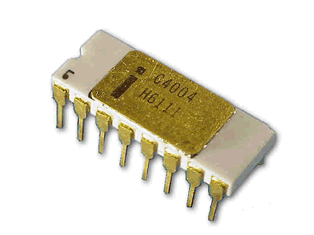
Co-invented the Intel 4004 "computer" on a chip: Intel 4004 BiographyAt age 15, he won a trip to Washington, D.C., and a $400 scholarship from the Westinghouse Science Talent Search. During the summers away from college he worked for General Railway Signal Company in Rochester where he designed two circuits that produced his first two patents.(4) One circuit detected trains through the audio frequencies transmitted along the railway track. Another absorbed energy to protect against lightning.(6) Entered Stanford as a National Science Foundation Fellow in 1955 Between September 1968 and April 1969, Ted Hoff started to develop a family of chips for a Japanese calculator company. These chips were intended for a calculator that would come out under a brand called Busicom. When he suggested to the japanese engineers to make better use of the memory by simplifying the functions the Japanese were not interested in making changes. But Bob Noyce told him and Stan Mazur to go ahead and what resulted was a general purpose computer. Ted Hoff also developed the instruction set for that computer what essentially became the instruction set for 4004 microprocessor. Since neither Hoff nor Mazur knew much of CMOS technology it was Federico Faggin to get the chip on silicon in 1971.
The chip had as much power as the ENIAC, which filled 3,000 cubic feet with 18,000 vacuum tubes.
When a headhunter contacted him in early 1983, he was
ready for a change and joined Atari as vice president of technology. "Atari
was doing some interesting things at the time, like looking at the
role computers could play in the home and special graphics kinds
of things," he says. But Atari's consumer product, video
games, began to slip rapidly about a year after he joined. Warner,
which owned Atari, sold it in mid-'84. Hoff was offered a position
with the new owner, Commodore, a consumer electronics company that
was trying to expand its product line. But he wasn't sure where he
would fit in, so he went off on his own. Chronology 1937 Born in Rochester, New York 1954 Graduated from Rensealler Polytechnic Institute in Troy, NY, in electrical engineering (BEE). 1959 received a MS in Electrical Engineering. 1962 Received his PhD at Stanford University in Electrical Engineering. 1968 Hired as employee number 12 by Intel Corporation. 1974 Patent 3,821,715 (US) issued June 28, 1974 1980 Named the first Intel Fellow, the highest technical position in the company. 1982 Joined Atari 1986 Vice President and Chief Technical Officer with Teklicon, Inc
Honors and Awards 1988 received the IEEE Computer Society Pioneer Award. 1996 Inducted into the National Inventors Hall of Fame. 1997 George R. Stibitz Award The Stuart Ballantine Medal from the Franklin Institute. Received the IEEE's Cledo Brunetti Award and its Centennial Medal. Received the Rensselaer Polytechnic Institute's Davies Medal. Fellow of the IEEE. Member of: the American Association for the Advancement of Science, Eta Kappa Nu, Tau Beta Pi and Sigma Chi.
|

|
Last Updated on December 8, 2005 | For suggestions please mail the editors |
Footnotes & References