Ctesibius

|
Achievements Ctesibius is best known for three major inventions:
Other inventions:
Biography Alexandrian Greek, the inventor of the force-pump and water organ, and improver of the clepsydra or water-clock. The principle of the siphon has been attributed to him. He was the teacher of Hero of Alexandria.
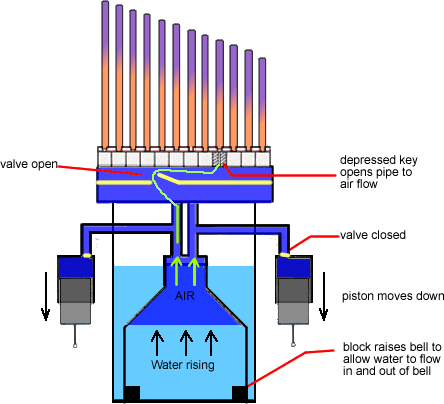
He had invented an early variety of pump and wanted to connect it to a wind instrument. He wanted continuous sound, but unfortunately the organ only played a sound when the piston was moved in the cylinder and the pump took as long to breathe in as it took to breathe out. However, he had also noticed that an upturned bucket pushed down into water stayed dry inside. He realised that air was being stored in the bucket under pressure so, instead of connecting the pump to the organ, he connected both to the bucket. As air was forced into the bucket, water rose up in the bowl. By using the air to raise water in the bowl the air was kept under pressure by the water even when the pump was breathing in. This device, the Hydraulis (water-organ), was played by keys operating valves to let air into the organ pipes, and was powered by a pump attached to the water chamber. This gave a continuous sound - just like an organ. Ctesibius was also responsible for transforming a legal device into a clock so accurate that it would not be surpassed until the seventeenth century. In Alexandrian courtrooms a defendant was permitted to speak for a certain regulated time. The device they used to ensure fairness was the clepsydra - 'captured water' - and was a simple jar with a hole. A specific quantity of water - measured according to the crime - was poured into the container and the defendant could speak until the water ran out. Although simple and fair, it was somewhat imprecise. Ctesibius wanted to transform the clepsydra from a device to indicate the end of a given time into a continuously working clock. He noticed that the water dripped out faster when the jar was full, slowing as it emptied. Consequently it was of no use for displaying time during the process. His simple solution was to ensure the jar was always full. He introduced a second container with a bigger hole, which dripped faster to ensure the clepsydra remained full and so dripped at a constant rate. A clepsydra that never emptied was of no value, however, so he had to find a way to measure the water that came out, and for this he used a float with a pointer in a third container. More accurate mechanical clocks using falling weights instead of water appeared in the fourteenth century, and the ingredients for the modern clock were in place when Galileo described the pendulum in the sixteenth century. However, it was not until 1657 that the Dutch physicist Christiaan Huygens showed how a pendulum could be used to regulate a clock, and only then was the first mechanical clock more accurate than that of Ctesibius, invented some 1,800 years previously.(1)
From Wikipedia, the free encyclopedia Ctesibius (Ktesibius) (working 285 - 222 BC) of Alexandria was second only to Archimedes as an inventor and mathematician. His lost work (fire in the library) on the elasticity of air: pneumatics still earns him the title of father of pneumatics, for the first treatises on the science of compressed air and its uses in pumps and even a cannon, are his. Like all his other works, however, it has not survived. Even his Memorabilia, a compilation of his research, cited by Athenaeus, is lost. Ctesibius was probably the first head of the Museum of Alexandria. Unfortunately, very little is known of his life and work. In his age Ctesibius was miserably poor, if Diogenes Laertius can be trusted, who recounts how the generous philosopher Arcesilaus, "when he had gone to visit Ctesibius who was ill, seeing him in great distress from want, he secretly slipped his purse under his pillow; and when Ctesibius found it, 'This,' said he, 'is the amusement of Arcesilaus.' His work is chronicled by Vitruvius, Athenaeus,and Philo of Byzantium who repeatedly mentions him, adding, with an almost audible sigh, that the first mechanicians had the advantage of being under kings who loved fame and supported the arts. Proclus, the commentator on Euclid, and Hero of Alexandria, the last of the engineers of antiquity, also mention him.
note of the editor: When the library of Alexandria burned down all of Ctesibius records were lost. Over 2000 years of science and literature went lost in that fire, who knows where science would have been when these records were not gone up in flames.
Chronology
Honors and awards
Bibliography "Memorandum on mechanics", "Belopoietica": Works on
mechanics and engines of war, both lost.
|
||||||||||||||||||||||||||||||||||||||||||||||||

|
Updated on May 14, 2006 | For suggestions please mail the editors |
Footnotes & References
| 1 | http://www.bbc.co.uk/history/historic_figures/ctesibius.shtml |
| 2 | http://www.tmth.edu.gr/en/aet/1/31.html |
| 3 |