


If you would like to give a helping hand please let us know


K. Eric Drexler coined the term of nanotechnology in his book Engines of Creations (1986). He envisioned the idea of using individual atoms and molecules to build living and mechanical "things" in miniature factories. His vision is that if scientists can engineer DNA on a molecular scale, why can't we build machines out of atoms and program them to build more machines?
The requirement for low cost manufacturing creates an interest in the "self replicating manufacturing systems," studied by von Neumann in the 1940's. These "nanorobots, " programmed by miniature computers smaller than the human cell, could go through the bloodstream curing disease, perform surgery, etc. If this technology comes about the barriers between engineered and living systems may be broken.

Noblepricewinner and chemist Jean Marie Lehn (University Louis Pasteur, Strasbourg, France) describes nanotechnology as a large area of small technology. Sometimes nanotechnology is material engineering; another time chemistry, electronics, biology or medicines. There is only one way to get the picture and that is by seeing examples.(2)

It all begins while experimenting with the invention of a very high definition microscope called a ‘scanning tunneling microscope’ by Russell D. Young in 1971. He describes the microscope as an instrument that like a blindfolded person 'feels' the surface and scans atom by atom. In that way it is possible to create an image of any particular surface on atomic scale. It takes nearly 20 years to realize his idea through an experiment conducted by .
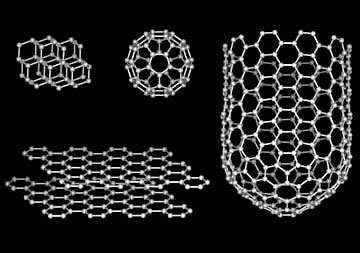
British Nobel price winner Harry Kroto (University of Sussex,
UK) received his price in 1996, sharing that with the Americans Richard
Smalley and Robert Curl, for the discovery of a football shaped carbon molecule
later called ‘buckyball. There are also tube like shapes (see above)
called nanotubes. Just like buckyballs they are pure carbon with an atomic
structure closely resembling chicken wire. If we are able to produce cables
from this material the cables would be 100 times stronger than steel and
six times lighter, says Kroto.
Cees Dekker a researcher from University of Delft, the Netherlands, uses
nanotubes to make them serve as conductor. Nanotubes bridge the gap between
two electrodes.

| |
Last Updated on 23 November, 2005 | For suggestions please mail the editor in chief |
Footnotes & References