
Microsoft Company 15 September 1975
Chapter 1
this page is sponsored by:
your sponsor message could be here |
|
Microsoft Company 15 September 1975Chapter 1 | this page is sponsored by:
|
|---|
| visit microsoft's museum |

History of Microsoft
 Hobbyists
became entrepreneurs - some more successfully than others. Personal computers
proliferated, with no standards and no preconceived notions of what these
new machines could be or could do. It was an adventure shared by a virtual
handful of enthusiasts...
Hobbyists
became entrepreneurs - some more successfully than others. Personal computers
proliferated, with no standards and no preconceived notions of what these
new machines could be or could do. It was an adventure shared by a virtual
handful of enthusiasts...
World's
First Minicomputer to Rival Commercial Models
While
Hobbyists around the USA were trying to figure out how to piece together systems
from parts found in electronics shops, MITS (Micro Instrumentation and Telemetry
Systems) of Albuquerque, New Mexico, announced the MITS Altair 8800 on the cover
of the 1st January 1975 issue of Popular Electronics.
The
MITS Altair inspired a new generation of technology enthusiasts, including Bill
Gates and Paul Allen, who were among the first of these early hobbyists to realize
that the key to the future of personal computing lay in the unlimited potential
of software.
"This
is it!" says Paul Allen, waving a copy of Popular Electronics in his hand.
"it's about to begin!" On the cover is a mockup of the MITS Altair,
the first personal computer.
| Dr. John G. Kemeny and Thomas Kurtz developed the BASIC language at Dartmouth in 1964. BASIC stood for "Beginner's All-Purpose Symbolic Instruction Code". Their objective: to create a simplified computer language for teaching students how to program. Gates and Allen recognized that the compact design of BASIC made it ideal for the limitations of the first personal computers, which had extremely restricted memory and processing power. |
Allen,
employed by Honeywell and his friend Bill Gates, a sophomore at Harvard, immediately
set out to adapt BASIC for the machine, working in marathon 24-hour sessions.
Using the Altair's published specifications, Gates and Allen created a simulator on a DEC PDP-10 computer that allowed it to emulate the MITS machine. Working day and night, they created the first version of MICROSOFT BASIC for the Altair
Jan 2, Bill Gates and Paul Allen complete BASIC
Allen is going to deliver it to MITS president Ed Roberts in Albuquerque. Realizing he didn't have a way to load it into the computer, Paul Allen hand assembled a loader program for BASIC at 30,000 feet in the air, on the flight to New Mexico. Even though it had never been tested on an actual machine, it ran perfectly on the very first try.
They license BASIC to their first customer, MITS of Albuquerque, New Mexico, the manufacturer of the Altair 8800 personal computer. This is the first computer language program written for a personal computer.
Jan
3, Paul Allen joins MITS (Micro Instrumentation and Telemetry Systems)
as Director of Software. , and Gates follows him later that year to form an
informal partnership called Micro-soft, complete with hyphen.
The
"MITS Mobile" travels through the western United States demonstrating
the Altair and "Micro-soft" BASIC. It also unwittingly distributes
copies of not-quite-ready-for-prime-time (i.e., pirated) BASIC.
March
7, The MITS Altair newsletter, Computer Notes, declares, "Altair
BASIC -- Up and Running."
July
1, Bill Gates' and Paul Allen's BASIC officially ships as version 2.0
in both 4K and 8K editions.
July
22, Paul Allen and Bill Gates sign a licensing agreement with MITS
regarding the BASIC Interpreter. Microsoft is not yet an official partnership.
In fact, the name has not even been chosen.
Nov 29,
In a letter to Paul Allen, Bill Gates uses the name "Micro-soft" to
refer to their (60/40)(3) Partnership. This is the earliest
known written reference.
Homebrew
Computer Club meets for the first time (in Gordon French's garage) in Menlo
Park, California.
The
Computer Mart opens on Madison Avenue in New York. Zilog Z-80 chip is introduced.
Stats
Revenues: $16,005
Employees: 3 (Allen, Gates, and Ric Weiland)
MITS promotes Altair BASIC, the computer language developed by Gates and Allen
for the Altair computer. Hobbyists are ecstatic, despite the fact that, even
with BASIC, there is little you can actually do with the Altair.
The "MITS Mobile" travels through the western United States demonstrating
the Altair and "Micro-soft" BASIC. It also unwittingly distributes
copies of not-quite-ready-for-prime-time (i.e., pirated) BASIC.
Steve
Jobs and Steve Wozniak announce the Apple I personal computer, for only $666.66!
(2) A price high but affordable for someone really wanting
to buy his own computer.
Shugart
introduces the 5.25-inch floppy disk drive at $390. Three computer magazines
arrive: BYTE, Computer Graphics & Art, and Dr. Dobb's Journal of Computer
Calisthenics and Orthodontia.
April
Fools!
Apple Computer is formed with the introduction of the Apple I on April Fool's
day 1976. Out of the garage and into the history books, Steve Jobs and Stephen
Wozniak build the first single circuit board PC complete with video interface
and 8K of RAM and a keyboard. The system incorporated some cost saving
components including the MOS Technologies 6502 processor and dynamic RAM. Various
potential investors were shown the prototype Apple I which was mounted on a
piece of plywood with all components visible. A computer hobbyist group; the
Homebrew Computer Club based in Palo Alto, California previewed one of the prototypes
and its innovative features. A local computer dealer owner who agreed to sell
the units required that they were assembled which was not the norm for customers
buying computers at the time. Once displayed in his store, almost all the Apple
I systems sold in the next ten months. 200 Apple I systems were built before
the introduction of the Apple II. Jobs and Wozniak continued building systems
out of their garage for two years before the move to the current Apple headquarters
in Cupertino, California.
March
27, Twenty-year old Bill Gates gives the opening address at the First Annual
World Altair Computer Convention (WACC) held in Albuquerque, New Mexico.
July 1,
Microsoft refines and enhances BASIC to sell to other customers including DTC,
General Electric, NCR, and Citibank.
November 1,
Paul Allen resigns from MITS to join Microsoft full time.
November 26,
The tradename "Microsoft" is registered with the Office of the Secretary
of the State of New Mexico "to identify computer programs for use in automatic
data processing systems; pre-programming processing systems; and data processing
services including computer programming services." The application says
that the name has been in continuous use since November 12, 1975.
Microsoft
develops its first ad campaign, called "The Legend of Micro-Kid."
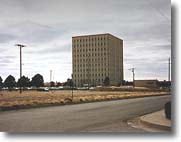 Although still an informal partnership, Microsoft moves to its first real offices
in One Park Central Tower in Albuquerque. Gates returns to Harvard for the spring
term, but finds time to direct Microsoft in its efforts to license BASIC to
General Electric, NCR, Citibank, and others.
Although still an informal partnership, Microsoft moves to its first real offices
in One Park Central Tower in Albuquerque. Gates returns to Harvard for the spring
term, but finds time to direct Microsoft in its efforts to license BASIC to
General Electric, NCR, Citibank, and others.
February 3,
Bill Gates is one of the first programmers to raise the issue of software piracy.
In his "An Open Letter to Hobbyists," first published in MITS newsletter
"Computer Notes" and later in several other newsletters and magazines),
Gates accuses hobbyists of stealing software and thus preventing "...good
software from being written." "If you are STILL using Altair BASIC
1.1, you have a copy that was stolen in March 1975!"
He prophetically concludes with the line, "...Nothing would please me more
than being able to hire ten programmers and deluge the hobby market with good
software."
Stats
Revenues: $22,496
Employees: 7
MITS sponsors the World Altair Computer Convention (WACC) in Albuquerque, for
Altair owners, dealers, programmers, and anyone interested in microcomputers.
The convention features a 20-year-old as the keynote speaker: Bill Gates.
Microsoft develops its first ad campaign, called "The Legend of Micro-Kid."

Digital
Research markets CP/M (Control Program for Microcomputers) operating system,
seeks to set standard.
Tandy
Corporation announces TRS-80 Model 1 microcomputer.
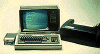
Commodore Business Machines introduces Personal Electronic Transactor (PET)
computer. 
Apple Computer introduces Apple II. 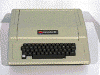
Branching
Beyond BASIC, Microsoft develops FORTRAN, COBOL, and Assembler, extending the
capabilities of the PC into scientific and business realms.
July
1, The company ships its second language, (Microsoft's version of) FORTRAN,
and begins offering BASIC on a single-copy basis.
 Other First-generation machines that ran Microsoft BASIC included
computers from Atari, Cromemco, and Texas Instruments, built around a mind-numbing
range of processors that included the Z-80, 8080, 6800, 6809, 6502, and 68000.
Because most machines had unique designs with proprietary (and usually primitive)
operating systems, the Microsoft development team had to create a specialized
version of each language for each computer.
Other First-generation machines that ran Microsoft BASIC included
computers from Atari, Cromemco, and Texas Instruments, built around a mind-numbing
range of processors that included the Z-80, 8080, 6800, 6809, 6502, and 68000.
Because most machines had unique designs with proprietary (and usually primitive)
operating systems, the Microsoft development team had to create a specialized
version of each language for each computer.
With the introduction of inexpensive microprocessors such as the Intel 8080 and the MOS 6502, a few people began to dream of actually having their own computers.
With BASIC in demand, Microsoft branches out
February 3, A partnership agreement between Paul Allen and Bill Gates is officially
executed. Their main product is still BASIC, but it's tied up with MITS, which
has agreed to make a "best effort" to license it to other companies.
In Bill and Paul's view, however, MITS is making less effort than it should.
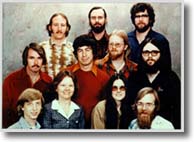 The
picture shows:
The
picture shows:
Starting from the top, left: Steve Wood, Bob Wallace & Jim Lane
Next row: Bob O'Rear, Bob Greenburg, Marc McDonald & Gordon Letwin
Next row: Bill Gates, Andrea Lewis, Marla Wood & Paul Allen
November 18,
Arbitration decides the matter in Microsoft's favor, setting the company free
to market BASIC to others. Within months, Microsoft licenses BASIC for the Commodore
PET and TRS-80 computers, and begins negotiating with other companies. BASIC
product. BASIC has been the subject of an extended legal dispute between the
two companies.
Presidents
Bill Gates and Paul Allen shared the title of general partner until 1977, when Bill Gates became president and Paul Allen vice president of Microsoft Corp.
Stats
The BASIC Foundation for a company
Revenues: $381,715
Employees: 9
Microsoft's flat fee of $21,000 for what becomes Applesoft BASIC seems like
a good idea at the time, until Apple sells more than a million machines with
BASIC built in. Put your calculators away; it works out to 2 cents per copy.
5.25-inch
disk drives arrive for Tandy and Apple computer systems. 16-bit microprocessors
are here. Intel introduces the 8086 chip. Al Gore coins the phrase "information
highway." First COMDEX computer show in Las Vegas
Apple
co-founder Steve Wozniak wrote Integer BASIC, the first language available for
the machine. But it was quickly supplanted in popularity by Microsoft Applesoft
BASIC.
 The Personal Electronic Transactor -better known as the Commodore PET- had an
integrated, self-contained design and was aggressively priced at less than $800.
Microsoft developed its first 6502-based BASIC for the Commodore and sold the
source code to Apple. The machine used a cassette recorder for loading and storing
data.
The Personal Electronic Transactor -better known as the Commodore PET- had an
integrated, self-contained design and was aggressively priced at less than $800.
Microsoft developed its first 6502-based BASIC for the Commodore and sold the
source code to Apple. The machine used a cassette recorder for loading and storing
data.
Introduced
in 1977 and licensed to Apple, Applesoft BASIC offered a richer set of programming
commands as well as floating-point arithmetic, allowing for the development
of the first generation of business-oriented applications. Applesoft BASIC was
first made available on tape and disk, then provided in ROM on the popular Apple
II Plus. In addition, the company offered the Applesoft Compiler for customers
who wanted the faster performance possible with compiled code.
April 11, Microsoft announces its third language product, Microsoft COBOL-80.
November 1,
Microsoft establishes its first international sales office in Japan. Microsoft
appoints ASCII Microsoft, located in Tokyo, as its exclusive sales agent for
the Far East. Organizing the new operation is Kazuhiko Nishi, founder and publisher
of Japan's popular ASCII magazine
December 31,
Microsoft's year end sales exceed $1 million dollars
Seattle
natives Gates and Allen announce plans to return home and set up offices in
Bellevue, Washington, becoming the first microcomputer software company in the
Northwest. A meeting between Japanese computer magazine publisher Kay Nishi
and Bill Gates prompts the establishment of ASCII Microsoft, a Japanese company
that markets Microsoft products to original equipment manufacturers, dealers,
and end users. Interestingly enough, although the products are in English, they
sell well. Microsoft is still exclusively in the business of developing languages,
and Microsoft BASIC is the language of choice for the entire burgeoning industry.
Beyond
the BASICs: Microsoft introduces COBOL-80.
Stats
Revenues: $1,355,655
Employees: 13
Anticipating the success of the 16-bit processor, Microsoft begins development
of simulators in order to speed and simplify code development.
International
The first international office is established when Microsoft forms a strategic partnership with Kazuhiko Nishi, founder of ASCII Corporation in Japan.
January 1,
Microsoft moves its offices to Bellevue, Washington from Albuquerque, New Mexico.
After moving to Bellevue, Microsoft continues to grow in employees, sales,
and vision. Microsoft has a BASIC compiler for virtually every microcomputer
on the market. However, the company recognizes that languages are only a part
of the picture, which is why Microsoft makes its first foray into the mass-market
possibilities of personal computers by forming the Consumer Products Division,
created to develop and market retail products and to provide support for individual
users.

Although
titles such as Olympic Decathlon and Adventure are among the company's consumer
hits, this effort is eventually folded back into the company, and the consumer
market doesn't really take off for more than a decade.
April 4,
Microsoft 8080 BASIC is the first microprocessor product to win the ICP Million
Dollar Award. Traditionally dominated by software for mainframe computers, this
recognition is indicative of the growth and acceptance of the PC industry.
June
18, Microsoft announces Microsoft BASIC for the 8086 16-bit microprocessor.
This first release of a resident high-level language for use on 16-bit machines
marks the beginning of widespread use of these processors.
November 29,
Microsoft expands its service to the European market with the addition of a
new representative, Vector Microsoft, of Belgium. Microsoft has already established
contracts with ICL, Phillips, R2E, and several other OEMs.
First
entry into the European market. Vector International, based in Haasrode, Belgium,
signs on to represent Microsoft.
VisiCalc
spreadsheet program wows industry at West Coast Computer Faire.
WordStar
by MicroPro International seeks to become top word-processing program.
Get
"On-Line" with the Source of CompuServe.
Stats
Revenues: $2,390,145
Employees: 28
By working closely with NEC and its PC-8001 computer, Microsoft extends its
worldwide effort of working closely with computer manufacturers in the development
of hardware.
International
First entry into the European market. Vector International, based in Haasrode, Belgium, signs on to represent Microsoft.
Apple
Computer goes public. 4.6 million shares, largest offering since Ford Motor
in 1956. Novell, Inc. announces that it will develop network software. One million
computers installed in the U.S.
April 2, 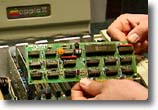 Microsoft SoftCard -one
of the company's first hardware products- made it possible to run programs
designed for the CP/M operating system on the Apple II.
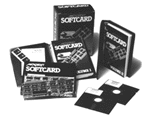
Microsoft SoftCard -one
of the company's first hardware products- made it possible to run programs
designed for the CP/M operating system on the Apple II.
Microsoft announces the Microsoft Z-80 SoftCard, a microprocessor on a printed
circuit board that plugs into the Apple II computer and allows owners to run
thousands of programs available for the 8080/Z-80 class of computers with only
minor modifications. Microsoft will provide BASIC, FORTRAN, and COBOL languages
for the Z-80 SoftCard. (A version for the ill-fated Apple III was also available.)
SoftCard was an enormous success in early-day computer terms, and Microsoft
sold more than 100,000 units between 1977 and 1982.
Microsoft
announces Microsoft XENIX OS, a portable operating system for 16-bit microprocessors.
It is an interactive, multi-user, multi-tasking system that will run on Intel
8086, Zilog Z8000, Motorola M68000, and DEC PDP-11 series. All of Microsoft's
existing system software (COBOL, PASCAL, BASIC and DBMS) will be adapted to
run under the XENIX system, and all existing software written for UNIX OS will
be compatible as well.
June
11, Microsoft hires Steve Ballmer. He will be responsible for establishing
policies and procedures in the financial, organizational, and resource allocation
areas.
 Although the company grows by only two employees sales more than triple. Microsoft
introduces the Pascal language, develops XENIX (enhanced version of the UNIX
operating system), and begins to explore spreadsheet applications. It also releases
its first hardware product, the Microsoft SoftCard, which allows Apple II users
to run CP/M-80 (operating system from Digital Research -nope, no MS-DOS yet!)
applications. The biggest of the big news, however, is still a big secret: a
contract with IBM to develop languages for their first personal computer. Wow.
But it gets better. They need an operating system too!
Although the company grows by only two employees sales more than triple. Microsoft
introduces the Pascal language, develops XENIX (enhanced version of the UNIX
operating system), and begins to explore spreadsheet applications. It also releases
its first hardware product, the Microsoft SoftCard, which allows Apple II users
to run CP/M-80 (operating system from Digital Research -nope, no MS-DOS yet!)
applications. The biggest of the big news, however, is still a big secret: a
contract with IBM to develop languages for their first personal computer. Wow.
But it gets better. They need an operating system too!
Stats
The Dawning of a Decade
Revenues: $7,520,720
Employees: 40
Steve Ballmer arrives from Procter & Gamble to serve as the first assistant
to the president. Ballmer's arrival eases Bill Gates's administrative burden
and allows the company to hire "lots of good people."
 With MS-DOS running on over 150 million
PCs, it's easy to forget that it wasn't always the international phenomenon it
is today.
With MS-DOS running on over 150 million
PCs, it's easy to forget that it wasn't always the international phenomenon it
is today.
The arrival of the 16-bit IBM personal computer in 1981 set in motion a new era of computing, as the personal computer industry quickly left behind its early 8-bit days.
Within a few years, the industry would coalesce around two primary operating systems: Microsoft MS-DOS and the Apple Macintosh.
A transition of significant proportions -from mainframe to personal computing- was also underway, supported by the evolving de facto standards that were beginning to emerge in the PC marketplace.
 The original
IBM Personal Computer was actually introduced with several options in operating
systems, including the CP/M-86 from Digital Research and the UCSD P-System.
But the IBM PC represented a new platform for computing, which -like all shifts
in this industry- offered a shift in the paradigm of computing and allowed for
the creation of new products with new capabilities. Building on the core of
a product acquired from Seattle Computer Products, Microsoft took advantage
of the technology breakthroughs represented by the IBM PC and, in the evolving
versions of MS-DOS, provided a foundation for an entire generation of computing.
The original
IBM Personal Computer was actually introduced with several options in operating
systems, including the CP/M-86 from Digital Research and the UCSD P-System.
But the IBM PC represented a new platform for computing, which -like all shifts
in this industry- offered a shift in the paradigm of computing and allowed for
the creation of new products with new capabilities. Building on the core of
a product acquired from Seattle Computer Products, Microsoft took advantage
of the technology breakthroughs represented by the IBM PC and, in the evolving
versions of MS-DOS, provided a foundation for an entire generation of computing.
After
months of maniacal hours by developers, the IBM personal computer debuts with
Microsoft's Disk Operating System (MS-DOS). Other companies set out to clone
this new hardware standard, negotiating with Microsoft for the rights to distribute
MS-DOS (which IBM, under pressure from Bill Gates and company, has authorized).
Because the clones are not strictly compatible, Microsoft creates a different
MS-DOS for each machine. Newly incorporated Microsoft also rides the wave of
the IBM PC with versions of BASIC, COBOL, and Pascal.
August 12,
IBM introduces its Personal Computer, which uses Microsoft's 16-bit operating
system, MS-DOS 1.0, plus Microsoft BASIC, COBOL, PASCAL, and other Microsoft
products.
After months of maniacal hours by developers, the IBM personal computer debuts
with Microsoft's Disk Operating System (MS-DOS). Other companies set out to
clone this new hardware standard, negotiating with Microsoft for the rights
to distribute MS-DOS (which IBM, under pressure from Bill Gates and company,
has authorized). Because the clones are not strictly compatible, Microsoft creates
a different MS-DOS for each machine. Newly incorporated Microsoft also rides
the wave of the IBM PC with versions of BASIC, COBOL, and Pascal.
Steve
Jobs of Apple visits Microsoft to give a sneak preview of the revolutionary
Macintosh computer. Microsoft becomes the first major company to develop products
for the Mac.
On
June 25, 1981 Microsoft reorganizes into a privately held corporation with Bill
Gates as President and Chairman of the Board, and Paul Allen as Executive Vice
President. Microsoft becomes Microsoft, Inc., an incorporated business in the
State of Washington.
Stats
Revenues: $16,000,000
Employees: 128
The
Microsoft Local Area Network (MILAN) is now fully functional, linking all of
Microsoft's in-house development computers including a DEC 2060, two PDP-11/70s,
a VAX 11/250 and many MC68000 machines running XENIX. This system will simplify
e-mail delivery on-site.
In
its first 16 months on the market, MS-DOS is licensed to 50 hardware manufacturers,
but there is never any guarantee that it will become an industry standard. While
promoting MS-DOS and working on enhancements to it, Microsoft also expands its
international focus, opening Microsoft Ltd. In England, thus building the first
truly global personal computer software company. Plus, Microsoft moves into
the realm of business applications with the introduction of Multiplan, an electronic
spreadsheet program.
 June 28, Microsoft announces a new corporate
logo, new packaging, and a comprehensive set of retail dealer support materials.
The new logo for Microsoft Corporation, dubbed the "Blibbet," will
be officially launched at Fall/COMDEX '82. The logo design is the name, Microsoft,
with a distinctive letter "o" filled with horizontal lines.
June 28, Microsoft announces a new corporate
logo, new packaging, and a comprehensive set of retail dealer support materials.
The new logo for Microsoft Corporation, dubbed the "Blibbet," will
be officially launched at Fall/COMDEX '82. The logo design is the name, Microsoft,
with a distinctive letter "o" filled with horizontal lines.
A
prototype Macintosh arrives at Microsoft to aid in development of applications
for it.
On
June 25, 1982, James Towne, 39, was appointed president and chief operating
officer of Microsoft (July 6 1982 -- June 20 1983). In July, Towne took over
all operating responsibilities from Bill Gates. Previously, Towne had been
vice president and general manager of the instrument division at Tektronix
Inc.
Stats
A Market Explodes
Revenues: $24,486,000
Employees: 220
An
essential decision in the early development of MS-DOS was to make it an open
system, designed to run on multiple computers.
To stretch memory beyond the original 640K limits of the Intel 8086 chip set, Lotus, Intel, and Microsoft introduced the LIM/EMS standard for expanding memory.
Although competition grew fierce in the languages market -especially with the arrival of fire-sale-priced Borland Turbo Pascal at $49- Microsoft continued overall to be the industry leader in languages. Microsoft BASIC was enhanced and became GW-BASIC (for "gee-whiz"), used for everything from specialized programs to "quick-and-dirty" coding. The company also helped move the high-end market (where customers included several of our direct competitors) from Pascal to C with the release of the Microsoft C programming language.
The proliferation of systems running MS-DOS helped simplify software development and provided consumers with a single platform available across a wide range of feature sets and price points, helping to spark the growth of the entire industry.
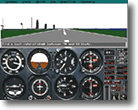 If you wanted to test a new
machine for IBM compatibility, one of the standard programs you'd run would
be Microsoft Flight Simulator, a true-to-life simulation of what it's like to
pilot a plane, developed in cooperation with Bruce Artwick of SubLogic. Flight
Simulator logged in more than one million copies in a decade, making it a genuine
highflyer.
If you wanted to test a new
machine for IBM compatibility, one of the standard programs you'd run would
be Microsoft Flight Simulator, a true-to-life simulation of what it's like to
pilot a plane, developed in cooperation with Bruce Artwick of SubLogic. Flight
Simulator logged in more than one million copies in a decade, making it a genuine
highflyer.
Not
even Microsoft bet the entire company on MS-DOS alone. The company also developed
the XENIX operating system, a UNIX derivative designed to bring its multiuser
capabilities to personal computers, announced in 1980. While the multiuser PC
market was smaller, XENIX was still a relative success, outpacing all other
versions of UNIX by a wide margin. Later Microsoft transferred its rights to
XENIX to The Santa Cruz Operation.
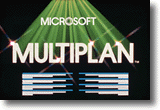 The Microsoft Multiplan spreadsheet, the company's first
application product, was ported across many different types of computers -a
major issue in the early days of MS-DOS, when "IBM compatible" could
mean anything from "will run the program" to "can read IBM disks
but probably not do much more". While Lotus 1-2-3 surpassed Multiplan in
domestic markets, Multiplan was the winner in almost every other country in
which it appeared, helping to lay the groundwork for Microsoft's strong international
presence.
The Microsoft Multiplan spreadsheet, the company's first
application product, was ported across many different types of computers -a
major issue in the early days of MS-DOS, when "IBM compatible" could
mean anything from "will run the program" to "can read IBM disks
but probably not do much more". While Lotus 1-2-3 surpassed Multiplan in
domestic markets, Multiplan was the winner in almost every other country in
which it appeared, helping to lay the groundwork for Microsoft's strong international
presence.
 Introduced
in 1983 and costing $800, the Tandy/Radio Shack PC Model 100 redefined the concept
of portability in personal computing. It included built-in text editing, spreadsheet,
and communications programs. Microsoft worked closely with Tandy in the definition
and development of the machine.
Introduced
in 1983 and costing $800, the Tandy/Radio Shack PC Model 100 redefined the concept
of portability in personal computing. It included built-in text editing, spreadsheet,
and communications programs. Microsoft worked closely with Tandy in the definition
and development of the machine.
Hard
disks started to become standard equipment on computers with the introduction
of a 10-MB hard disk as an available option with the IBM PC XT.
September 29,
While most customers still think of Microsoft as a technically oriented systems/language
company, two products form this year set the groundwork that will eventually
change the public's perspective of the company: Microsoft Word for MS-DOS 1.00
PC World subscribers receive a free demonstration floppy disk of Microsoft Word
in the magazine's special Software Review. "This is the first time in the
history of publishing that a magazine has featured a floppy-disk bind-in,"
said David Bunnell, Publisher of PC World.
November 10,
Microsoft unveils Microsoft Windows, an extension of the MS-DOS operating system
that provides a graphical operating environment. Windows features a window
management capability that allows a user to view unrelated application programs
simultaneously. It also provides the capability to transfer data from one application
program to another.
 Word is significant for its WYSIWYG (what you see is what you get) design,
though WYSIWYG at the time means little more than on-screen italics, bold,
and underline. Even so, Word produces output far superior to any other product
of its kind to date. Windows is significant in providing a graphical interface
for users of MS-DOS.
Word is significant for its WYSIWYG (what you see is what you get) design,
though WYSIWYG at the time means little more than on-screen italics, bold,
and underline. Even so, Word produces output far superior to any other product
of its kind to date. Windows is significant in providing a graphical interface
for users of MS-DOS.
May 2,
Microsoft introduces the Microsoft Mouse, a low-cost, hand-held pointing device
for use with the IBM PC, as well as, any MS-DOS-based personal computer. The
Mouse is used to quickly move or reposition a cursor on the screen. Two buttons
are provided to select decision alternatives or commands from the screen.

December1,
Microsoft announces that MSX-DOS, an 8-bit disk operating system for MSX microcomputers,
will be available to 14 Japanese and one U.S. micro manufacturers next January.
MSX-DOS is CP/M-80 2.2 compatible and runs all Microsoft's 8-bit software including
the languages BASIC, COBOL-80, and FORTRAN-80, and Multiplan.
Presidents
In August 1983, Jon Shirley, 45, joined Microsoft as president, chief operating officer and director. Prior to Microsoft, Shirley was vice president of computer merchandising at Tandy Corp. and had held a variety of positions in sales, merchandising, manufacturing and international operations. At Microsoft, Shirley provided the young company with the professional business acumen needed to steer it through the birth of the Windows operating system, the move to the Redmond campus and the initial public offering.
Stats
Revenues: $50,065,000
Employees: 476
After recovering from a serious illness, Paul Allen leaves Microsoft to explore
a variety of other pursuits - from technically oriented companies to the Portland
Trailblazers basketball team.
International
Subsidiaries open in the three major European markets: France, Germany, and
the United Kingdom. They are charged with selling into and developing the European
market as a whole.
APAC region established with purchase of Wiser Laboratories Pty, Ltd. of Australia,
giving us direct distribution in the region. First Microsoft e-mail message
sent internationally. International head count at year's end: 42.
January 24,
Microsoft takes a leading role in developing software for the Apple Macintosh
computer. The company ships Microsoft BASIC and Microsoft Multiplan simultaneously
with the introduction of the Macintosh. Microsoft also announces that Word,
Chart, and File will ship soon.
Microsoft's original software development work for Macintosh was code-named
"SAND" for "Steve's Amazing New Device".
Recognizing
early the limitations of the closed design of the Macintosh system, Microsoft
for a while marketed MacEnhancer, which provided the ability to plug non-Apple
printers, modems, and other devices into the Mac. Although Apple itself would
eventually change its product design to allow the same kinds of capabilities,
the MacEnhancer never took off.
Bill
Gates attended the introduction of the Apple Macintosh computer on January 20,
1984, and appeared in the original Macintosh brochure standing alongside Mitch
Kapor of Lotus and Fred Gibbons of Software Publishing.
SAND
was a fitting tribute to Apple's Steve Jobs, who oversaw the Macintosh project.
Excited by the possibilities of a commercially viable machine with a graphical
user interface, Microsoft made an early and major commitment to Macintosh development
and has consistently been among the most successful of all software companies
in development for the Macintosh marketplace. The company shipped two products
-BASIC and Multiplan- on the same day the Macintosh was introduced, followed
closely by Word, Chart, and File.
Originally
explored in the 1960's and 1970's at the Stanford Research Institute and at
Xerox PARC in Palo Alto, California, graphical user interfaces began to appear
in commercial systems in the early 1980's. Xerox itself was among the first,
with its Star system. Apple introduced both Lisa ("Local Integrated System
Architecture") and Macintosh computers. But these early systems were hampered
by hardware constraints and too slow to satisfy many of the early, inflated
user expectations.
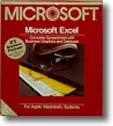 The Microsoft
Excel spreadsheet for the Macintosh not only advanced the state of the art in
a way that re-enthused the dwindling customer base for the Macintosh, but also
provided the essential technology basis for the Windows versions of Microsoft
Excel a few years later, which reset the counter for the spreadsheet industry
on the PC-compatible platform.
The Microsoft
Excel spreadsheet for the Macintosh not only advanced the state of the art in
a way that re-enthused the dwindling customer base for the Macintosh, but also
provided the essential technology basis for the Windows versions of Microsoft
Excel a few years later, which reset the counter for the spreadsheet industry
on the PC-compatible platform.
Microsoft has the software for it
Having worked closely with Apple during the development of the Macintosh, Microsoft is positioned to be the leading developer of applications for the machine, offering BASIC, Multiplan, File, Word, and Chart. Organizationally, Microsoft separates its systems and applications groups and creates a hardware and peripherals division. Work continues on Windows, but May, September, and year-end dates all slip as product definition and development go through constant evolutions and reevaluations.
March 22,
Microsoft Press introduces its first two titlesCary Lu's "The Apple Macintosh
Book," and Peter Norton's "Exploring the IBM PCjr Home Computer,"at
the 1984 West Coast Computer Faire.
April 1,
Microsoft announces the creation of a new Hardware and Peripherals Division
under the direction of William Roland. This division will be dedicated to developing
and marketing hardware products that complement Microsoft's software product
line.
July 31,
Microsoft announces a new Key Dealer Program designed to generate corporate
sales in major U.S. markets. The dealers will provide their corporate clients
with comprehensive post-sales training and support.
August 14,
Microsoft announces that IBM has chosen Microsoft XENIX and MS-DOS for its new
generation personal computer, the IBM PC AT. The new PC sets a standard in multi-user
systems by endorsing XENIX. In addition, IBM continues to support MS-DOS. Both
operating systems support the Intel APX-286(80286) microprocessors chosen for
the new IBM microcomputer.
September 24,
Microsoft announces that Francis J. Gaudette is joining Microsoft as Vice President
of Finance and Administration. In his new position as Chief Financial and Administrative
Officer Gaudette will report directly to Jon Shirley, President.
Stats
Mac Attack
Revenues: $97,479,000
Employees: 608
Microsoft Press, a one-year-old division, introduces its first books: Cary Lu's
The Apple Macintosh Book and Peter Norton's Exploring the IBM PCjr Home Computer.
International
The number-one selling software product in France is Microsoft Multiplan (French version, naturellement).
Microsoft links its campus-wide e-mail system to all Microsoft subsidiaries. Frank Gaudette is hired as chief financial officer.
Pronounced
"gooey", a GUI, or graphical user interface, enables users to connect
with their computers in an interactive, intuitive way.
Seeing
early the limitations of character-based interfaces and recognizing that advances
in hardware performance would make possible a shift in the computing paradigm
to a graphical user interface, Microsoft began development of Windows in the
early 1980's.
The result? The most popular user interface in the history of computing, now running on more than 75 million machines worldwide. And still growing by millions of new users every month.
A
wide selection of mini-applications shipped as part of the original Windows
package, including:
From the Start, Windows was designed to work seamlessly with the Microsoft Mouse. But the desire to make the program usable by the broadest base of users determined that Windows would also be controllable via keyboard commands.
"Windows will instantly deliver you a more productive present. And a leap
into the future." [From original Windows advertising]
Real-world metaphors -such as toolbars, menus, and icons- help the user understand
the computer on human terms.
Character-based technology was simple but it could be fast, because to the computer
the screen appeared as a small character grid, typically 80-by-25 blocks of
pixels (and the original PC even had a 40-character mode, displayable on a television).
Graphical interfaces demand more computing horsepower because the computer must
control every single pixel individually instead of in blocks -a VGA screen,
for example, sets up a 640-by-480 grid, or more that 300,000 individual pixels.
Although it exceeded the company's internal expectations, Windows 1.0 was more
a critical success than a commercial one. Nevertheless, it set Microsoft firmly
on the path to graphical user interfaces and committed the company to an industry
leadership role in the definition of what a GUI should be.
Many early customers of Windows were more interested in its task-switching capabilities
-the ability to work with more that one program at a time- than in its graphical
features.
Microsoft
celebrates its tenth anniversary by shipping the first retail version of the
Windows graphical environment. Cost in the U.S. is $99. But there are no more
than a handful of programs that run on Windows, so market acceptance is slow.
This, coupled with Macintosh sales that are stuck in a holding pattern, leads
some industry observers to wonder if graphical user interfaces are really as
inevitable as Microsoft is predicting. Apple Macintosh sales begin to pick up
after Microsoft Excel for the Macintosh is premiered at Tavern on the Green
in New York.
August 12,
Microsoft celebrates its 10th anniversary with sales figures for the fiscal
year of 1985 of $140 million. The company has 900 employees and a diverse product
line including industry standards like operating systems, languages, business
software, hardware, and computer "how-to" books.
September 3,
Microsoft announces that it has selected the Republic of Ireland as the site
of its first production facility outside the U.S. The Ireland facility, located
at Sandyford, County Dublin, will be a Duplication and Distribution Center for
Microsoft software products to be sold in the European market.
November 20,
Microsoft announces the retail shipment of Microsoft Windows, an operating system,
which extends the features of the DOS operating system. Windows provides users
with the ability to work with several programs at the same time and easily switch
between them without having to quit and restart individual applications.
Stats
Revenues: $140,417,000
Employees: 910
Microsoft ships its one-millionth unit of Multiplan.

International
Ireland selected as the location of first production facility outside the United States. Manufacturing processes pioneered at the Dublin site are later imported to U.S. production facilities.
Microsoft builds its first overseas manufacturing facility in Ireland.
In
1986 the company introduced Microsoft Works, which integrated word processing,
spreadsheet, database, communications, and drawing functions into a single program.
SCSI
(Small Computer Systems Interface) specification is accepted as an ANSI standard
to become yet another acronym to add to your list. Pronounced "scuzzy",
the specification is defined to allow printers, disk drives, and other peripherals
the ability to distribute data independent of their host, allowing the computer
to be freed up for more user-oriented tasks. Soon to follow is the concept of
the SCSI "chain" where several peripherals are connected to one SCSI
host adapter taking up only one slot in the computer.
This may sound somewhat complicated, but before SCSI the computer had to "learn"
quite a bit about any peripheral you planned to attach and keeping up with current
technology was a hopeless endeavor. With SCSI, minimal hardware and software
engineering is necessary for new system designs and integration.
By adopting this standard, hardware manufacturers were able to create brand
new products that didn't sacrifice compatibility with existing computers
 March 13, Motivated by a desire to provide value to an increasing number of employee
shareholders, Microsoft stock goes public at $21.00 per share, rising to $28.00
per share by the end of the first trading day. Initial public offering raises
$61 million.
March 13, Motivated by a desire to provide value to an increasing number of employee
shareholders, Microsoft stock goes public at $21.00 per share, rising to $28.00
per share by the end of the first trading day. Initial public offering raises
$61 million.
The
company holds its first International Conference on CD-ROM technology.
February 26,
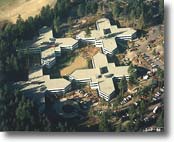
During that same busy March, Microsoft moves to its new four-building corporate
campus Buildings 1 through 4, in Redmond. surrounding "Lake Bill"
in Redmond, Washington. As if that isn't enough, the company holds its first
International Conference on CD-ROM technology.
Opening
of Microsoft de Mexico is a double first: the first Latin American
subsidiary for Microsoft and the first office established anywhere in Latin
America by a U.S. software company.
Though IBM in the year 1917 - then still called Computing-Tabulating-Recording Company - already opened an office in Brasil, nearly 70 years earlier. (4) IBM then was not a software company.
December31,
Microsoft announces that, at the end of 1986, Microsoft employees number 1,442.
1,162 are employed domestically, and 280 are employed internationally.
Microsoft
receives the 1986 Washington State Governor's Export Award in the service firm
category.
Microsoft
Works, an integrated program with word processor, spreadsheet, database, and
communications modules, is introduced for the Macintosh.
Stats
Revenues: $197,514,000
Employees: 1,442
International
Opening of Microsoft de Mexico is a double first: the first Latin American subsidiary for Microsoft and the first office established anywhere in Latin America by a U.S. software company.
While
the huge commercial success of Windows was still one version away, Microsoft
Windows version 2.0 introduced a host of important technical advances.
"Save
the Blibbet!" A year of firsts -first Windows application, first CD-ROM,
first appearance of a new logo
Unlike the hyphen in Micro-soft that quietly faded away, some employees don "Save the Blibbet" buttons in support of the old Microsoft logo when the new one is introduced. The Blibbet, however, is memorialized only by the "Blibbet Burger" sold by the Marriott grills on campus. Microsoft and IBM announce a joint development agreement for OS/2 and release OS/2 version 1.0. Rather than adopting Windows, IBM insists on developing Presentation Manager, a separate graphical interface. Microsoft releases Microsoft Excel for Windows -its first application for the Windows operating system- and continues to explore new technologies shipping its first CD-ROM product: Bookshelf, a reference collection.
April 2,
Microsoft announces Microsoft Operating System/2 (MS OS/2) a new personal computer
operating system. It has been designed and developed specifically to harness
the capabilities of personal computers based upon the Intel 80286 and 80386
microprocessors. It is planned for phased release to OEMs in the fourth quarter
of 1987. This is the first product to be announced as a result of the Joint
Development Agreement between IBM and Microsoft announced in August, 1985.
April 2,
Microsoft announces Microsoft Windows 2.0, offering compatibility with existing
Windows applications and a new visual appearance compatible with Microsoft OS/2
Presentation Manager. In addition to the new visual appearance, it uses a system
of overlapping windows, rather than tiled windows. Windows 2.0 also includes
significant performance enhancements and improved support for expanded memory
hardware.
March 24,
Microsoft combines it End-User and OEM support services into a single Product
Support Services group in order to serve customers more effectively.
July 30,
Microsoft announces that it has completed an agreement to acquire Forethought,
Inc., an applications software company. Forethought develops and markets PowerPoint,
a leading desktop presentation application, and is the exclusive distributor
of FileMaker Plus, a top-selling database for Apple Macintosh systems. Under
the agreement, Forethought becomes Microsoft's Graphics Business Unit which
will be headed by Robert Gaskins.
September August 87
Microsoft announces the shipment of its first CD-ROM application, Microsoft
Bookshelf, a collection of 10 of the most popular and useful reference works
on a single CD-ROM disk. Bookshelf is the first general purpose application
to bring the benefits of CD-ROM technology to personal computer users.
October 6,
Microsoft announces Microsoft Excel for Windows. This first Windows application
offers interactive, dynamic linking of sheets; one-step, automatic macro re-order;
and sophisticated, high-resolution printed output. It also contains a completely
integrated, on-sheet database management, and easily customizable graphs. Excel
will run under Microsoft Windows 2.0 and Windows/386 at shipment, and will be
available for OS/2 shortly thereafter.
Microsoft
introduces LAN Manager, a LAN operating system that runs on both MS-DOS and
OS/2.
Stats
Revenues: $345,890,000
Employees: 1,816
Windows 286 and Windows 386 are announces.
International
Microsoft Ireland ships its one millionth package. Arabic version of MS-DOS is introduced. International head count at year's end: 460.
January 13,
Microsoft and Ashton-Tate announce the Microsoft SQL Server, a relational database
server software product for Local Area Networks (LANs). It is based on a field-proven
relational database management system licensed by Microsoft from Sybase, Inc.,
and enhanced with technology from Microsoft and database technology from Ashton-Tate.
First shipment is planned in the second half of 1988.
The
Business Software Association is formed to combat software piracy. Computer
virus by 23-year-old hacker infects more than 6,000 computers on the Internet.
Installed base for MS-DOS reaches 30 million users.
Microsoft
and IBM announce the delivery of the jointly developed Operating System/2 (OS/2)
1.1 with Presentation Manager. Presentation Manager is the graphical user interface
(GUI) for the OS/2 operating system. This is the second major release of the
Standard Edition of OS/2.
Microsoft
becomes the top software vendor, and never looks back...
By
only a small edge, Microsoft surpasses rival Lotus Development Corporation as
the top software vendor. Microsoft hires Mike Maples from IBM to provide direction
in the applications division. Maples reorganizes the group into five business
units: graphics, analysis, data access, office, and entry. In another key business
move, Microsoft's manufacturing and distribution division moves to a 260,000
square-foot facility -Canyon Park- in Bothell, Washington. To keep the ever-increasing
number of customers happy and productive, the company establishes a new Product
Support Services facility, handling more than 1,000,000 calls per month.
April August 88
Microsoft moves into the new Manufacturing and Distribution site in Canyon Park,
in Bothell. The 245,000 sq. ft. facility houses not only Manufacturing staff,
but the Warehouse and Distribution staffs which used to be at Parmac. Fulfillment
and Export are also now located at Microsoft Campus North.
June 14,
Microsoft appoints Mike Maples Vice President of the Applications Software Division.
He will report to Jon Shirley, President.
Microsoft
sells its one-millionth Mouse.
Stats
Revenues: $590,827,000
Employees: 2,793
Microsoft and Hewlett-Packard are sued by Apple Corporation. Apple alleges
copyright infringement.
International
International operations make up 48 percent of Microsoft's annual sales. International Products Group (IPG) is set up in Ireland; Ireland ships it two millionth package.
June 5,
Microsoft announces the formation of the Multimedia Division, dedicated to
the development and marketing of multimedia systems software and consumer
products. The division will be headed by Min Yee, Vice President. Yee will
also continue as Publisher of Microsoft Press. He will report to Jon Shirley,
President.
August 1,
Microsoft announces that The Microsoft Office will soon be available on CD-ROM.
This is the first general business software for Macintosh systems to be made
available on CD-ROM.
The
first edition of Microsoft Office is released, on both standard disks and
CD-ROM.
No
one had predicted the lightning growth of Microsoft --we had expected the
original four buildings to provide enough room for five years or more. But
by 1989, Microsoft occupies almost the entire business park at the current
site, a fact recognized by renaming it "Microsoft Place" and establishing
"One Microsoft Way" as the official corporate address. The company
now reaches far beyond the confines of the Redmond campus, with international
operations accounting for more than half of annual sales. The consumer division
is reestablished. Company president Jon Shirley announces his pending retirement.
IBM
and Microsoft Expand Partnership
November 13,
Microsoft and IBM broaden the scope of their development agreement by agreeing
to jointly develop a consistent, full range of systems software offerings
for the 1990s. These software offerings will include enhancements to MS-DOS,
Microsoft OS/2, and Microsoft LAN (local area network) products, which will
work with the Intel 386 and 486 microprocessors.
December27,
Microsoft announces that Jon Shirley will retire as President and Chief Operating
Officer on June 30, 1990. Shirley, who has been President since August, 1983,
will continue to play a role in the management of the Company both as a member
of the Board of Directors, and as a consultant for strategic projects.
Stats
Revenues: $804,530,000
Employees: 4,037
Microsoft Word for Windows begins shipping.
International
Microsoft European Headquarters (EHQ) opens in Paris. International operations increase to 55 percent of annual sales.
The first edition of Microsoft Office is released, on both standard disks
and CD-ROM.
Microsoft employees give $1 million to United Way.
Microsoft buys a minority share in The Santa Cruz Operation, the leading developer
of UNIX.
April 2,
Microsoft announces the appointment of Michael R. Hallman as Company President
and Chief Operating Officer. He replaces Jon Shirley who is retiring June
30, 1990. Hallman will also become a member of the Board of Directors. He
was formerly with The Boeing Company.
April 9,
Microsoft introduces Russian MS-DOS 4.01. MS-DOS is the first Microsoft product
localized for the Soviet market. The Russian version brings the total number
of foreign-language versions to 13, including versions in Arabic, Chinese,
Hebrew, Japanese (Kanji), and Korean (Hangeul).
Featuring
a major redesign of its user interface, Microsoft Windows version 3.0 was
a number-one hit almost from the first day it arrived.
More
than four million copies of Windows were distributed in its first year, sparking
the release of more than 1,200 Windows-based applications from other developers.
Another six million copies sold the following year -bringing the installed base
to more than 10 million- and total commercial applications reached 5,000. It
was a phenomenon unlike anything the industry had ever seen. May 22,
Microsoft announces the immediate, worldwide availability of Microsoft Windows
3.0, at the City Center Theatre in New York. This version offers dramatic
performance increases for Windows applications, advances in ease of use and
aesthetic appeal, and straightforward integration into corporate computing
environments.
"Windows,
Windows, Windows," as Steve Ballmer would say
 Graphical computing begins to realize its full potential with the announcement
of Windows 3.0 at a major New York event on May 22. Supported by the largest
single marketing campaign in the company's history -more than $10 million
over a six-month period- Windows 3.0 sells 100,000 copies in two weeks. Steve
Ballmer excites everyone at the company meeting with a continual chant of
"Windows, Windows, Windows." (His enthusiasm damages his vocal cords,
but Steve is only silenced temporarily.) With revenues reaching $1.18 billion,
Microsoft becomes the first software company to exceed the $1 billion sales
mark -a fitting celebration for the company's fifteenth anniversary. Mike
Hallman joins Microsoft as president.
Graphical computing begins to realize its full potential with the announcement
of Windows 3.0 at a major New York event on May 22. Supported by the largest
single marketing campaign in the company's history -more than $10 million
over a six-month period- Windows 3.0 sells 100,000 copies in two weeks. Steve
Ballmer excites everyone at the company meeting with a continual chant of
"Windows, Windows, Windows." (His enthusiasm damages his vocal cords,
but Steve is only silenced temporarily.) With revenues reaching $1.18 billion,
Microsoft becomes the first software company to exceed the $1 billion sales
mark -a fitting celebration for the company's fifteenth anniversary. Mike
Hallman joins Microsoft as president.
July 25,
Kicking off its 15th anniversary celebration, Microsoft, with revenues of
$1.18 billion, becomes the first personal computer software company to exceed
$1 billion in sales in a single year.
August 30,
Microsoft announces the formation of a Consulting Services Group aimed at
helping large corporate customers better use Microsoft products to build complex
information systems. The group, Information Technology Integration Services
(ITIS), is headed by Robert McDowell. The group's initial offerings will include:
executive education, planning, design, custom development, and systems and
applications support. (The group is later renamed Microsoft Consulting Services.)
September 17,
Microsoft launches the Microsoft Windows Computing Marketing Program, the
largest single marketing campaign in the Company's history to date.
November 12,
Bill Gates unveils his vision of the future of computing in his keynote address,"Information
at Your Fingertips,"at Fall/COMDEX '90.
Presidents
Stats
Revenues: $1,183,446,000
Employees: 5,635
Bill Gates demonstrates his vision of the future of computing with an interactive
keynote address, "Information at Your Fingertips," at Fall COMDEX.
International
Microsoft adds distributors in Singapore, Indonesia, and Malaysia. MS-DOS
4.01 is the first product localized for the Soviet market. Thirteen foreign-language
versions of MS-DOS are now available.
Opening of Far East Research and Development Center in Japan.
The new Advanced Technology group is established for research and product
development.
The Federal Trade Commission begins investigating Microsoft for possible anti-trust
violations.
Microsoft's history now contains 2 chapters, click
on  to continue
Disclaimer Though the editors of this history are careful to verify their facts, it is possible, e.g. through missing information, that we have made errors. Please contact us when you are of the opinion that you have found a mistake or missing information |

 
  |
Last Updated on April 15, 2007 | For suggestions please mail the editors |
Footnotes & References